
Septic Tank Installation in Tallahassee FL
Building where the sewer line does not reach, or replacing a tank that has quit? Leon County, Wakulla County and the towns around Tallahassee each play by different septic rules, from springs-protection zones south of Capital Circle to red clay hills in Gadsden and Jefferson counties. We plan the system around your lot, walk you through the permit steps and install it to Florida code.
- New septic systems and full replacements
- Nitrogen-reducing systems for springs areas
- Soil and site checks before digging
- Tallahassee plus 5 nearby cities
✓ Licensed and insured. Many years in business serving the greater Tallahassee area.
Septic installation here starts with the ground and the rules
Tallahassee sits where red clay hills meet a sandy, cave-riddled plain. That change decides how a septic system has to be built, and the state has rules to match. Four numbers show up on almost every job.
None of this is a reason to worry. It is a reason to start with a site check instead of a shovel. Most surprises on a septic job come from water, soil or a setback nobody measured. We measure first.
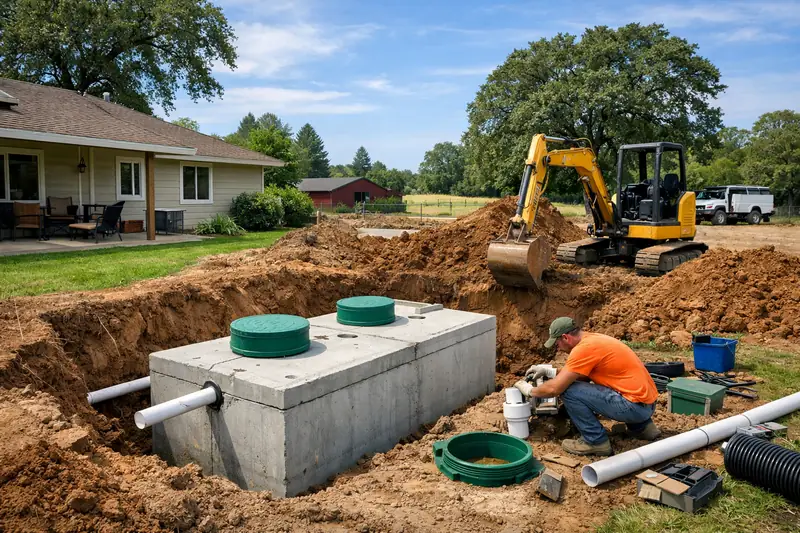
Septic services in Tallahassee FL
Pick the job that matches your property. Pick one to see steps, permits and local rules.
Septic tank installation
New system, start to finish.
Site evaluation and permits
Soil, water table, paperwork.
Drainfields
Rebuild a soaked or clogged field.
Nitrogen-reducing systems
For springs-zone lots.
Tank replacement
Swap a failing tank.
Abandonment and sewer hookups
Close an old tank.
From first call to final inspection
A septic job is a paper trail and a dig. Here is the usual order, so nothing catches you off guard.
- Site check. We look at lot size, slope, trees, wells, wet spots and where the house sits.
- Soil and water-table readings. These set the drainfield size and type. Wet-season water level is the big one.
- Design and permit paperwork. A site plan and application go to the state permitting office for your county.
- Install. Tank, lines, drainfield or treatment unit go in to the permitted plan.
- Inspection and cover. The system is inspected before it is covered up. Then the lot gets graded.
Who does the work?
Florida septic work is done by contractors registered with the state, and homeowners can look them up on the Florida Health contractor list. We are licensed and insured, with many years in business serving the greater Tallahassee area.
Conventional or nitrogen-reducing: which one fits your lot?
Both treat household wastewater in a tank, then in the soil. Nitrogen-reducing systems add a step that pulls out more nitrogen before the water reaches the ground.
| Compare | Conventional system | Nitrogen-reducing system |
|---|---|---|
| How it works | Tank settles solids, drainfield soaks liquid into soil | Tank plus a treatment step, then a drainfield |
| Nitrogen removed | Only 10 to 50 percent (UF/IFAS) | At least 65 percent (FDEP) |
| Where it is required | Where sewer or springs rules do not require more | Springs basin lots of one acre or less without sewer (FDEP) |
| What you maintain | Pump out on a schedule, keep the lid accessible | Same, plus service on the treatment unit |
Not sure which one your lot needs? The answer depends on the parcel map, not on guesswork. Our nitrogen-reducing systems page shows the three approved types and how to check your address.
Septic tank installation across the Big Bend
Tallahassee is the hub. Five nearby cities form the points of our service area, and five neighborhoods get their own pages because the ground and the rules differ from one to the next.
Septic system installation, drain field work and soil tests
People search for this work in different words. Septic system installation means the tank, the lines and the field going in together under one permit. The drain field, sometimes called a leach field, is the part that soaks treated liquid into the ground, so it is where most failures show up first. A soil test and water-table reading comes before any design. Our site evaluation page explains what is measured.
If your system is acting up, ask whether the answer is septic tank repair, a pump-out or a full replacement. A cracked tank and a soggy field are different jobs. Buying a house with septic? A voluntary septic inspection is smart even though Florida does not require one. Read our buyer checklist.
What a good written bid should list
- Septic tank size and the material it is made of
- Drainfield type, size and where it will sit on the lot
- Whether the system is conventional or nitrogen-reducing
- Permit and site-evaluation fees, shown separately
- Who handles the inspection call
- How the yard will be graded afterward
- What is and is not included, such as risers or an alarm
If a bid is one line long, ask for more. A real septic job has parts, and each part has a cost. See what drives septic costs here.
Ready to plan your septic system?
Tell us your city, your lot and whether sewer is on your street. We will tell you what to expect for septic tank installation in Tallahassee FL.
Septic guides for Tallahassee homeowners
Not ready to call? These pages answer the questions people ask first.
Wakulla Springs Septic Rules
Which lots need a nitrogen-reducing system and where the zone starts.
Read the rules →Questions we hear a lot
How much does septic tank installation cost in Tallahassee?
It depends on your lot, your soil, the system type and your permit fees, so we quote after a site visit. Systems that cut nitrogen cost more than conventional ones. Our cost guide lists what drives the price and what a written bid should show.
Do I need a permit to install a septic system in Leon County?
Yes. Florida requires a permit before a septic system is built, repaired, changed or closed. Since January 2, 2025, the Florida Department of Environmental Protection (DEP) runs septic permitting in Leon County (Florida Health notice). Our permit guide walks through the steps.
Do I need a nitrogen-reducing septic system?
You might. In springs basins, a new system on a lot of one acre or less must be nitrogen-reducing when sewer is not available (FDEP fact sheet). Most of Leon County south of Capital Circle sits in the Wakulla Springs protection zone (WCTV). Read the Wakulla Springs rules page and check your parcel.
How deep does the water table have to be under a drainfield?
Florida's rule is at least 24 inches between the bottom of the drainfield and the wettest-season water table (state rule text). Wet ground in the Big Bend is a big reason soil checks come before any design.
Can I connect to sewer instead of installing a septic tank?
If sewer is available to your lot, that is often the first option the state asks about. If sewer is not on your street, septic is the path. We can point you to who to ask, and we handle septic abandonment when you do hook up.
Which cities do you cover besides Tallahassee?
We work in Crawfordville, Quincy, Midway, Havana, Monticello, Woodville, Bradfordville and the Lake Munson and Southside area. See our locations page for what is different in each.
Let us look at your lot
A quick call or a short form is all it takes to get started. Call (850) 750-6657 or send your request, and we will respond about septic tank installation in your part of the Tallahassee area.
Back to the Tallahassee Septic Installation home page.